Chinese Pronunciation: Practise Tone Pairs in Words
Originally published
Learning a tone in isolation is a useful starting point. Next, practise it inside words and short phrases. Many common Mandarin words have two syllables, but Mandarin also has one-syllable and longer words. Pronouns and particles are not the only one-syllable words.
A tone pair is a way of organizing practice with two adjacent syllables. 今天 jīntiān, meaning “today,” has dictionary tones 1-1. 北京 běijīng, “Beijing,” has 3-1. 你好 nǐhǎo, “hello,” is written with 3-3, but the first third tone normally changes toward a second tone when these syllables are spoken together. Dictionary labels and the sound in a phrase are related, not identical.
What does a 20-cell tone-pair chart mean?
A common practice chart combines four full tones in the first syllable with five choices in the second: tones 1, 2, 3, 4 and the neutral tone. That gives 4 × 5 = 20 cells. It is a teaching grid, not a claim that every tone sequence in connected speech has only 20 possible sounds. The neutral tone depends on its surroundings, and tone changes and phrasing matter.
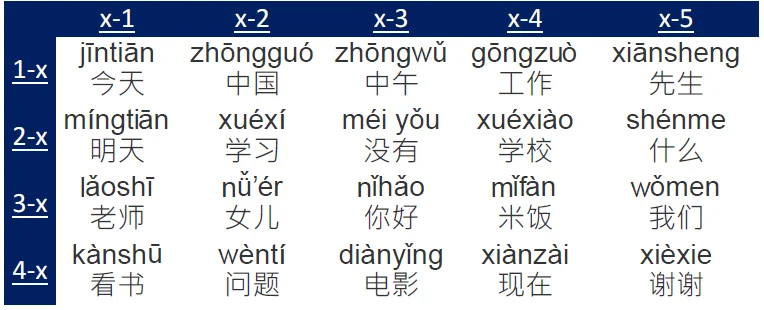
The chart is a reminder to practise combinations rather than treating every character as an isolated sound. Use a recording of a complete word alongside it. A drawn pitch contour does not capture every detail of timing or natural speech.
Practise a word, then try it in a phrase
- Choose a familiar two-syllable word and confirm its meaning and dictionary tones.
- Listen to a clear Mandarin recording of the whole word. Notice the transition between syllables, not just two separate shapes.
- Repeat the word, record yourself if useful and compare it with the model.
- Put it in a short phrase and listen again. For a third-tone pair, check the actual tone change instead of forcing two full falling-rising contours.
- If you can, ask a Mandarin speaker, tutor or language partner which syllable or transition sounds different. Work on that specific point and try a new example.
The longer archived tone-pair article contains the original practice discussion and chart resources. Its title reflects the original author's recommendation, not comparative evidence that one method is best for every learner.
Historical resources and feedback
The original article mentioned iTalki, the Sensible Chinese Pronunciation Package and WaiChinese as places to practise or find feedback. Those are historical recommendations. A former introductory price or promise of access is not a current verified offer; check each resource's present availability before using or paying for it. No purchase is required to try the practice steps above.
Feedback can help you notice a difference you missed. It does not guarantee faster fluency or make one service the only route to improvement. Keep listening, practising and checking complete words in context.
The original publication date is retained above. Counting, tone-change wording and historical-service caveats reviewed November 4, 2026. Julian K. Wheatley's MIT OpenCourseWare pinyin introduction discusses third tones in context. This is an edited historical tutorial, not an effectiveness study.