Chinese phrases with 看 and 爱: reading, watching and liking
Originally published
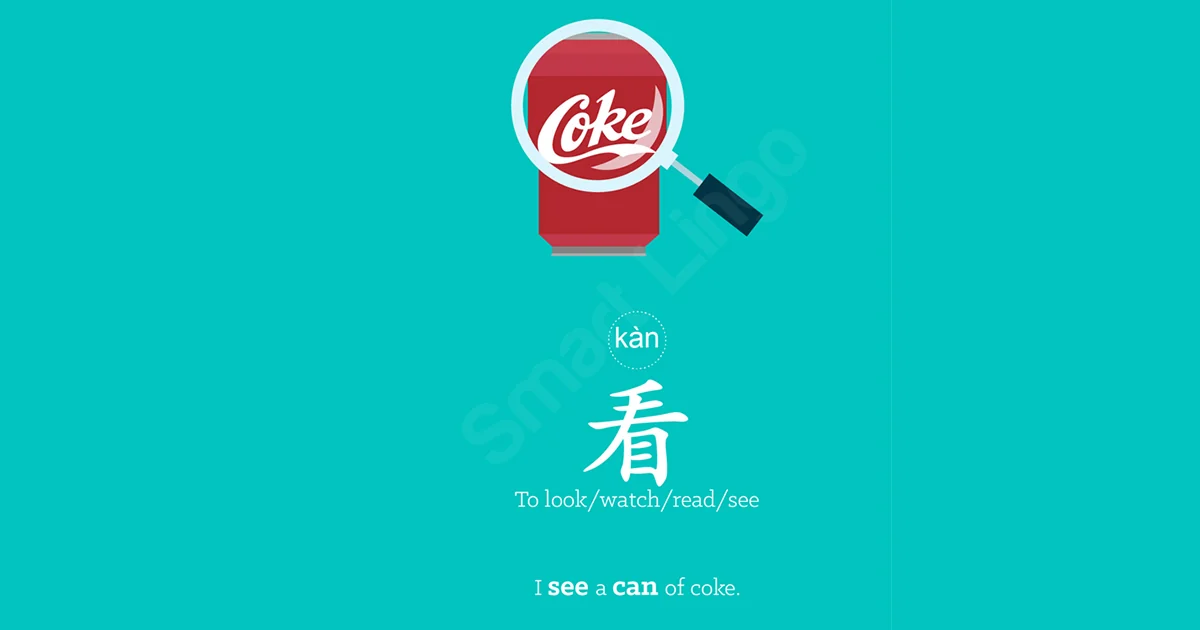
This beginner lesson was originally published on June 3, 2015, courtesy of That’s Mandarin. The surviving illustration pairs 看 with a can under a magnifying glass. That English wordplay can remind you of the character. For the Mandarin pronunciation, use kàn, with a falling tone. The five old audio links were unavailable when checked on November 28, 2026 (Baku time). The examples below can be read without a player.
Start with 好 in a greeting and a description
好 (hǎo) can mean good. In 你好 (nǐ hǎo), the whole expression is a greeting. 你好吗? (nǐ hǎo ma?) asks how someone is, with the question particle 吗 at the end. One possible reply is 我很好 (wǒ hěn hǎo), “I’m well.” 好朋友 (hǎo péngyou) means a good friend. 好久不见 (hǎo jiǔ bú jiàn) is a greeting for someone you have not seen for a long time.
好吃 (hǎochī) describes food that tastes good. 好喝 (hǎohē) does the same for a drink. You could say 这杯绿茶很好喝 (zhè bēi lǜchá hěn hǎohē), “this cup of green tea tastes good.” These expressions describe the food or drink. Later in the lesson you will use 爱 to say what someone enjoys doing.
Read a book or watch a film with 看
书 (shū) is a book. In 我看书 (wǒ kàn shū), 我 names the person, 看 gives the action, and 书 tells you what the person reads. Change 书 to 电影 (diànyǐng) and 我看电影 (wǒ kàn diànyǐng) means “I watch films” or “I watch a film,” as the context allows. 看 can describe looking, watching or reading. The object helps you choose the natural translation.
A simple Chinese sentence need not say that the action is happening at this very moment. To make that clear, try 我正在看书 (wǒ zhèngzài kàn shū), “I’m reading right now.” For the dictionary entry or a study card, keep the tones of kàn and shū. English “can” and “shoe” are loose memory cues, not recordings of the Chinese sounds.
Look for 书 in 书包 (shūbāo), a schoolbag, 书迷 (shūmí), a book lover, and 书法 (shūfǎ), calligraphy. Traditional calligraphy brings together brush, ink, paper and inkstone, often called the Four Treasures of the Study. The established expression 白面书生 (báimiàn shūshēng) can describe a bookish, inexperienced scholar. It is a set expression rather than a routine way to describe a young student.
Keep 买 and 卖 apart when shopping
买 (mǎi) means buy. 卖 (mài) means sell. 我买书 (wǒ mǎi shū) means “I buy books.” 我卖书 (wǒ mài shū) says that I sell them. Try covering the translations and reading the third tone in mǎi and the fourth tone in mài before checking which person is paying.
买东西 (mǎi dōngxi) means to buy things or go shopping. 买卖 (mǎimai), as a noun, means business or trade. 买单 (mǎidān) can mean to pay the bill. 网上 (wǎngshàng) means online, and 淘宝 (Táobǎo) is a name you may meet in reading about online shopping. 千金难买 (qiān jīn nán mǎi) describes something so precious that even a fortune would struggle to buy it.
Use 爱 to say what you like doing
爱 (ài) can mean love. 我爱你 (wǒ ài nǐ) says “I love you.” Before an activity, 爱 can express a strong liking or a habitual preference. 我爱喝茶 (wǒ ài hē chá) means “I love drinking tea.” 我爱看书 (wǒ ài kàn shū) says “I love reading books.” Swap 看 for 买 in 我爱买书 (wǒ ài mǎi shū) and the activity becomes buying books.
Compare 我爱买东西 (wǒ ài mǎi dōngxi), “I love shopping,” with 我要买东西 (wǒ yào mǎi dōngxi), “I want to buy something” or “I’m going to buy something,” depending on context. In the second sentence the character is 要 and the reading is yào. You can love shopping without intending to buy anything today.
In 爱好 (àihào), meaning a hobby or interest, 好 is read hào. In 可爱 (kě’ài), the whole word means cute or lovable. 看好 (kànhǎo) can mean to have a favorable view of someone or something, depending on the sentence. The original lesson also mentioned the dating show 非诚勿扰 (Fēi Chéng Wù Rǎo) and the expression 心动女生 (xīndòng nǚshēng) for a woman a participant was especially drawn to. These are cultural references from the original article. They do not establish current rules for the show or general rules about relationships.
Change one word and check your meaning
Say “I read books.” Then say “I love reading books” and “I love buying books.” The three answers are 我看书, 我爱看书 and 我爱买书. Point out the word that adds the preference and the word that changes the activity. Finally, tell a shopping partner “I want to buy a book.” One answer is 我要买一本书 (wǒ yào mǎi yī běn shū). The pinyin shows the dictionary tone of 一. Before běn it is normally pronounced yì.
For another way to build a sentence one part at a time, use the tea phrase lesson. If the letters in the illustration make you hear an English word, revisit the guide to pinyin and English pronunciation cues.